
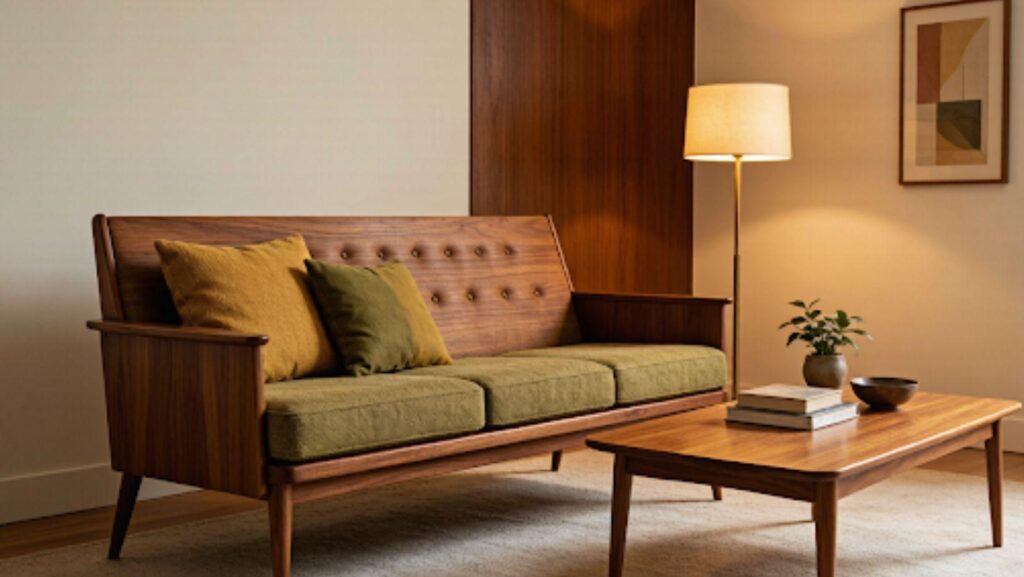
You have seen them everywhere mid century modern sofas and couches show up in almost every home tour and living room feed I scroll through. I suspect you feel the same pull. The clean lines and the little angled legs are easy to love, and they photograph well even on a bad phone.
So here is the real question I get asked most. Is mid century modern a passing fad, or is it a style that earns a permanent spot in your home? I will walk you through the history, the traits that make these pieces last, and the practical steps to pick one that fits your room and your budget without the usual buyer regret.
Why Mid Century Keeps Coming Back
The style grew out of the 1940s through the 1960s, a period when designers cared about honest function and clean form. Charles and Ray Eames, Eero Saarinen, and Florence Knoll built furniture for everyday homes, not just museums. That ordinary home focus is exactly why the look still feels current in a 2026 apartment.
Designers I read say mid century modern will not go out of style in 2026. One survey of professionals found about 60 percent believe the look is here to stay. When a style survives seventy years and still tops search charts, it stops being a trend and becomes a baseline you can build a room around.
I learned this the hard way. I bought a trendy purple sectional in 2018 and grew tired of it in two years. My mid century coffee table from the same era still gets compliments every week. The shape simply does not age the way loud colors do.
**The real reason it lasts is that the shape solves a problem: low profiles and tapered legs make small rooms feel open and calm.**
The Features That Actually Age Well
Not every retro sofa holds up. The ones that do share a short list of traits that you can check in the product photo. Here is what separates a keeper from a costume piece that looks dated next year.
|
Feature |
Why it lasts |
|
Tapered wooden legs, walnut, teak, oak |
Lifts the sofa off the floor so the room reads as open and airy |
|
Low bench style seat |
Sits below the window line and keeps sightlines clear |
|
Kiln dried hardwood frame |
Corner blocked frames stay square for decades of daily use |
|
High density foam with down wrap |
Keeps its shape instead of sagging after one year |
|
Minimal ornamentation |
No trendy trim to look dated when fashions shift |
When you shop, look at the legs first. If the legs are thick blocks or hidden by a skirt, the piece is borrowing the look without the engineering. Real MCM legs are slim, angled, and about 6 to 8 inches tall.
Color follows form in true MCM. Keep the sofa in a warm neutral and let one accent pillow carry the pop, so the recliner reads as design rather than as a colorful gadget dropped in the room.
Pick the Right Size for Your Room
Size matters more than color. A sofa that is ten inches too long will annoy you every single day, while a slightly wrong shade you will forget in a month. Measure your wall, then match it to a width below before you fall for a photo.
|
Room width |
Best sofa width |
Good fit |
|
Under 10 feet |
78 to 84 inches |
Loveseat or slim 3 seater |
|
10 to 13 feet |
84 to 90 inches |
Standard 3 seater |
|
13 to 16 feet |
90 to 100 inches |
Extended 3 seater or chaise |
|
Over 16 feet |
100 plus inches |
Sectional with one chaise |
Seat depth also decides comfort. A depth of 21 to 24 inches suits most adults who sit upright. If you like to lie down, look for 24 inches or a little more, but check that your legs still reach the floor or a footstool.
**Leave at least 60 to 80 cm of walkway in front so the room never feels crowded and you can reach the window.**
What to Put Around Your Sofa
Most buying guides stop at the sofa itself. The room still feels off if the pieces around it fight the shape, and that is the part most articles skip. I will give you the layout I use in my own living room.
Place a round or oval coffee table in front. The curved edge softens the sofa rectangle and gives the footrest room to extend. Pick a table about two thirds the sofa length so it feels connected, not lost.
Add a tripod or arc floor lamp on the sofa open side. Mid century lighting with a brass or matte black finish echoes the legs without looking like a replica you bought in a costume shop. A warm bulb at 2700K makes the wood glow.
Lay a rug that is large enough for the front legs to sit on, even when someone reclines. A small rug makes a big sofa look like it is floating in the wrong way. Aim for 8 by 10 feet in most living rooms and tuck the back legs off if needed.
**A single sculptural object on a sideboard beats a crowded shelf every time. Let the furniture be the art and the room stays calm.**
Fabric and Color Choices for 2026
Colors in 2026 lean into warm, grounded tones. Think charcoal, ink, espresso, moss, and smoky jade. Mustard, rust, and teal still work as accents against a neutral wall, but use them on a throw, not the whole sofa.
For fabric, performance velvet gives a luxe feel, boucle adds texture, and top grain leather wears for years. If you have kids or pets, pick a stain resistant performance weave and ask for removable covers so a spill is not a crisis.
I own a boucle MCM sofa and a leather one. The boucle hides pet hair better than I expected, while the leather wipes clean in seconds. Both still look new after three years of real life.
Common Mistakes to Avoid
- Buying a full matching set. Mix wood tones and eras so the room looks collected, not like a showroom floor.
- Forgetting the legs. Real MCM pieces show their legs. A skirted base hides the very detail that makes the style light.
- Choosing bright primary colors from the 1960s catalog. Today palettes are earthier and easier to live with.
- Skipping the measure. A sofa that blocks the window or the path will bug you forever, no matter how pretty.
Is It Worth the Spend?
You can spend from about 800 dollars for a solid budget piece up to 3500 dollars for a premium bench made model. I think the sweet spot is a well built sofa with a hardwood frame and a down wrapped seat, somewhere in the middle of that range.
The reason I recommend spending a bit more is the frame. A kiln dried hardwood frame stays square, while a pine or particle board frame wobbles within a year. You feel the difference every time you sit down.
**Buy once, cry once. A true mid century frame outlasts three cheap couches and still looks right a decade from now.**
Caring for the Wood and Fabric
A mid century sofa rewards a little care. Dust the wood legs with a soft cloth every couple of weeks, and treat them with a wood conditioner twice a year so the walnut or teak keeps its glow.
For upholstery, vacuum the crevices monthly and blot spills at once. A down wrapped seat benefits from a fluff and rotate every week, which keeps the cushions from developing a dip on one side.
**A ten minute routine each month is all it takes to keep the piece looking showroom fresh for a decade of daily use.**
Where to Shop Without Overpaying
You do not have to buy the famous name to get the look. Many makers now offer the tapered legs, low seat, and clean lines at a fraction of the designer price, with frames that are just as solid under the fabric.
Read the spec sheet, not the brand story. If the frame is kiln dried hardwood and the legs are real wood, you have most of what matters. The rest is marketing you pay for but cannot actually sit on.
If you are ready to bring the look home, look for mid century modern sofas that arrive fully assembled with solid wood frames that hold the design together.